Land Use Models in Brazil
Task 1 - Study the diagram below carefully. It represents how land is normally (not always) used in developing countries. The different zones represent what is normally found there (i.e. how the land is used).
The model below is based on cities in Brazil. The model has one similarity with the Burgess Model as the CBD is still in the centre.
However, in the MIC model the urban zones are less defined, the high class sector is very small and close to the CBD, there are no middle class housing zones (like the suburbs of the HIC’s), the largest zone is the shanty towns which are usually on the outskirts. Large-scale industry is often fairly recent and is sited along main routeways or around the edges. (source)
The model below is based on cities in Brazil. The model has one similarity with the Burgess Model as the CBD is still in the centre.
However, in the MIC model the urban zones are less defined, the high class sector is very small and close to the CBD, there are no middle class housing zones (like the suburbs of the HIC’s), the largest zone is the shanty towns which are usually on the outskirts. Large-scale industry is often fairly recent and is sited along main routeways or around the edges. (source)
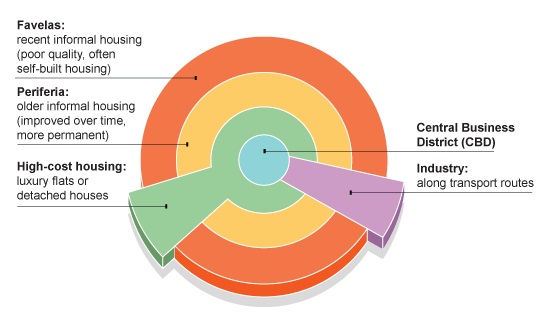
Source BBC Bitesize
Task 2 - Take a tour of the four different locations in Rio, Brazil.
Try to identify which of the zones each place represents.
Take a tour along the road, look up, look to the side and get an idea of what life is like.
Take a screen shot of a memorable view that you see and then write an account of that zone in less than 50 words next to the screenshot on your worksheet.
Try to identify which of the zones each place represents.
Take a tour along the road, look up, look to the side and get an idea of what life is like.
Take a screen shot of a memorable view that you see and then write an account of that zone in less than 50 words next to the screenshot on your worksheet.
|
|
|
Urbanization in Brazil - Rio de Janeiro
Below you will see a video filmed not in Brazil, but in Medellin, Colombia. This gives you a unique look the the structure and features of an informal settlement. Check it out!
Starter: Back to Brazil.... Click on this link to be taken to a rooftop view over the informal settlement (favela) of Rocinha close to Rio de Janeiro in Brazil. The people look a bit strange, but check out the view in front of you and behind you. What can you see and how do you know that this is an informal settlement? You can also check this one out from a bit higher up the mountain.
|
Objective: To find out why people move to Rio de Janeiro in huge numbers and the impacts that this has on the city.
**In preparation for this lesson, you should have watched the Ross Kemp on Gangs video** to the right. Note that there are some scenes of gang violence and some strong language. Viewer discretion required. Please complete the note taking tasks from the video on the starter worksheet above Now access the worksheet above. Starter. Find a suitable definition of the term 'urbanisation' and enter it onto your worksheet. Task 1. Using the CIA World Factbook for Brazil, find the data and enter it onto your worksheet for the indicators listed. Task 2 - The location. Watch the YouTube video and then study the Google map below to write a detailed description of the location of Rio and also our focus area, Rocinha. Help Needed? Click here |
|
Task 3 - Knowing more about shanty towns / favelas. This link will help.
a. Define a shanty town.
b. Explain how these informal settlements have grown.
c – State the types of materials that the houses are made from.
d. Create a spider diagram to show the problems that exist within favelas, and why informal settlements like Rocinha grow rapidly (push & pull factors).
e. Make a list of five possible locations that you may find shanty towns. Think carefully about land values and accessibility.
|
Task 4 - Check out the video to the right about the Olympics in Rio in 2016. Why are the government so concerned about favelas? What did they do about it? Task 5 - Do you think that favelas get bad publicity because of they way that they look? Is there more to these places than just drugs and guns? Check out the video here and make your notes on the worksheet. |
|
Impacts of Urbanization
To be added in 2022 - summary of impacts of urbanisation on people and the environment.
Improving Favelas - Option 1 (small group)

| IMPROVING SHANTY TOWNS - CLASSROOM PRESENTATION |
Task 2- (2 lessons) - Improving a Shanty Town - page 43-49 - More Thinking Through Geography. Excellent DME activity.
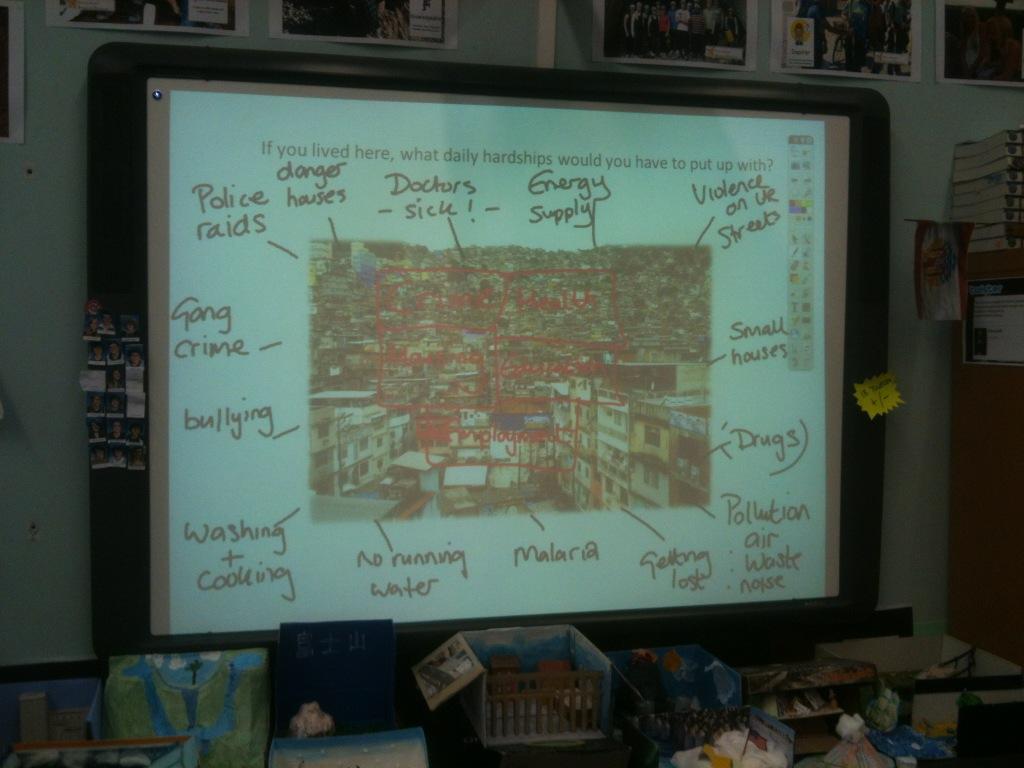
Here is the single PowerPoint slide to project on the board and annotate - like this
Task 3 - Now put together your exam answer. At the end, you must paste in the following sentence:
“Improving the favelas can never be a truly sustainable solution to the problems caused by rural to urban migration”
Explain why this is the case. What would have to be done to improve conditions? Go right back to the cause of the problem in terms of people moving from the rural areas. How can you limit that? Think about the 400 point card in the decision making process...
Thanks to Kevin Cooper as I have used extracts of his lesson here.
IMPROVING FAVELAS - OPTION 2 (large GROUP)
Starter - A 20 minute immersive interactive adventure.
Sometimes it is great to just watch and listen and not have to write anything! So, this is what you are going to do today to start the lesson. Through the magic of Google video, you are going to visit favelas in Rio and be guided around the different areas by a local woman who knows the place well.
Watch the videos below in order (on full screen) to get a feeling for these areas. These videos paint a very different story of Rio to the Ross Kemp documentary video that you previously watched.
|
|
|
|
|
Task 1 - What does a self help scheme look like? Use the worksheet below to annotate the key features of a self help scheme around the photo. This image might help you.
Now, download the PowerPoint presentation using the first tab beneath.
Task 2 - You are going to complete a short study to find out about four ways that places in Rio can be improved. To access this, click on the second tab below.
Complete the outstanding notes on the worksheet using the information on the PowerPoint to help you. The first two examples have been partially completed for you to give you an idea of what sort of detail is required.
Task 3 - Once the activities above are complete, you are going to answer the following IGCSE question on your Task 2 worksheet above:
“For a named city, describe attempts to improve the quality of life there” (7)
Exam Revision
Study the PowerPoint below. It gives you details of the main issues surrounding rural to urban migration as well as shanty town growth.
Additional Work
Improving Shanty Towns in India - Presentation here
Interactive Virtual Visit to an Indian Shanty Town.
“For a named city, describe attempts to improve the quality of life there” (7)
Exam Revision
Study the PowerPoint below. It gives you details of the main issues surrounding rural to urban migration as well as shanty town growth.
Additional Work
Improving Shanty Towns in India - Presentation here
Interactive Virtual Visit to an Indian Shanty Town.

| FAVELAS PRESENTATION |