
Extension Task
Make notes on the video beneath. Note the biology / geography cross over.
Make notes on the video beneath. Note the biology / geography cross over.
Tropical rainforests are mainly located between the tropics. The Amazon rainforest in South America is the largest rainforest in the world, but there are also large areas of rainforest in the Congo Basin, SE Asia, Central America, Southern India and Northern Australia. Tropical rain forests cover about 7% of the earth's surface. There typical climate are daily temperatures between 20°c and 45°c and annual rainfall of 125cm to 650cm. Rainforests tend to be very humid and experience thunderstorms in late afternoon. Rates of deforestation vary widely and even with the use of satellite images are hard to accurate clearly. Estimates claim about one and half acres are cleared every second which accounts for the area twice the size of Florida every year. Scientists believe that in 40 years all major rainforests may have disappeared.
Biodiversity & Change
Source: Elaine Miller
Objective 1: To explain the concept and importance of biodiversity in tropical rainforests.
Concept of biodiversity?
This link will help you to write a definition of biodiversity
The Importance
Read a printed out copy of this document
The Rainforest
Use the worksheet embedded on the blue tab beneath as well as both Integrated Approach & Planet Geography to complete all tasks thoroughly.
Additional Resources
For additional Information on the Emergent Layer - Click here
For the canopy - Click here
For the forest floor, click here.
You also need Integrated Approach, page 316-318 and for an overall definition, see below:
Concept of biodiversity?
This link will help you to write a definition of biodiversity
The Importance
Read a printed out copy of this document
The Rainforest
Use the worksheet embedded on the blue tab beneath as well as both Integrated Approach & Planet Geography to complete all tasks thoroughly.
Additional Resources
For additional Information on the Emergent Layer - Click here
For the canopy - Click here
For the forest floor, click here.
You also need Integrated Approach, page 316-318 and for an overall definition, see below:
|
Objective 2 - To examine the causes and consequences of reduced biodiversity in this biome.
Task 4 - Over to you ... Open the Worksheet above the video. Sort the statements into a table with the following headings: 1. Why are rainforests important? 2. Why are rainforests being destroyed? 3. What problems does rainforest destruction cause? Now use three highlighter colours to show which of the above are social, environmental, economic (SEEP) and add a key at the bottom of your table. **January 2013 Update** - Click here to read & watch the embedded video in the BBC News article on a 'Rainforest Census' that is about to start in the Amazon Rainforest. Print a copy of this article and summarise the initiative. Task 5 - The situation in Brazil. Pressure 1 - Dam Building Pressure 2 - Deforestation (better news) Pressure 3 - Urbanisation Solution 1 - National Park (see map to right) Management Strategy - RIL (Reduced Impact Logging) Using the four reference points above, complete the following two Paper 1 style questions (target 14 minutes for each). Outline the causes and consequences of a reduction in biodiversity in the tropical rainforest (7) Evaluate one or more strategies aimed at managing the loss of biodiversity in a rainforest biome. (7) |

TED Talks Embedded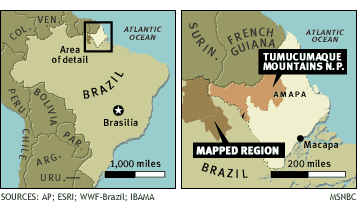
| ||