
Leisure at the local scale: Tourism
(Coursework Link)
i.Tourism management in urban areas
For one named city or large town:
• describe the distribution and location of primary and secondary tourist resources
• discuss the strategies designed to manage tourist demands, maximize capacity and minimize conflicts between local residents and visitors and avoid environmental damage.
Task 1 - Make a note of the following definitions
What is a Primary & Secondary Tourist Resource?
•Tourism is dependent upon the attractive power of the destination’s primary resources:
*Natural resources (climate, landscape, ecosystems);
*Cultural resources (urban heritage, arts, archaeological values, traditions)
*Social resources (potential tourism developers with socio-demographic characteristics, abilities, financial capital, knowledge)
•Moreover tourist destinations provide secondary resources:
*Accommodation sector (hotel, motel, camping, guest house etc.)
*Catering sector (café, restaurants, bistro etc.)
*Travel organisation sector (agencies, tour operators etc.)
*Transportation sector (air, boat, train, bus, etc.)
*Entertainment sector (Gambling, disco, etc.)
*Information sector (tourism information network)
*Supplementary services, facilities and service infrastructure
Task 2 - Use the following link: http://www.lonelyplanet.com/italy/venice
Map out the main attractions in Venice. Click on 'Sights’ (Primary) and comment on the location and spread around Venice. Take a screen shot and add the image to your word document underneath your description.
Annotate other Primary Resources onto your map of Venice.
Secondary Tourism Resources in Venice
Using the same website, one by one, overlay shopping, restaurants and entertainment to the map. Take a screen shot of each and comment on the distribution and location of these features in relation to the primary features.
For one named city or large town:
• describe the distribution and location of primary and secondary tourist resources
• discuss the strategies designed to manage tourist demands, maximize capacity and minimize conflicts between local residents and visitors and avoid environmental damage.
Task 1 - Make a note of the following definitions
What is a Primary & Secondary Tourist Resource?
•Tourism is dependent upon the attractive power of the destination’s primary resources:
*Natural resources (climate, landscape, ecosystems);
*Cultural resources (urban heritage, arts, archaeological values, traditions)
*Social resources (potential tourism developers with socio-demographic characteristics, abilities, financial capital, knowledge)
•Moreover tourist destinations provide secondary resources:
*Accommodation sector (hotel, motel, camping, guest house etc.)
*Catering sector (café, restaurants, bistro etc.)
*Travel organisation sector (agencies, tour operators etc.)
*Transportation sector (air, boat, train, bus, etc.)
*Entertainment sector (Gambling, disco, etc.)
*Information sector (tourism information network)
*Supplementary services, facilities and service infrastructure
Task 2 - Use the following link: http://www.lonelyplanet.com/italy/venice
Map out the main attractions in Venice. Click on 'Sights’ (Primary) and comment on the location and spread around Venice. Take a screen shot and add the image to your word document underneath your description.
Annotate other Primary Resources onto your map of Venice.
Secondary Tourism Resources in Venice
Using the same website, one by one, overlay shopping, restaurants and entertainment to the map. Take a screen shot of each and comment on the distribution and location of these features in relation to the primary features.
Task 3 - Read this article (conflicts) from 2013 and then this article (manage tourism demands, capacity & environmental damage) from November 2013 on the BBC. Use a highlighter pen to highlight the following:
Strategies designed to manage tourist demands
Strategies to maximize capacity
Strategies to minimize conflicts between local residents and visitors
Strategies to avoid environmental damage.
IB Exam Practice
Evaluate the strategies to manage tourist demands, maximize capacity and minimize conflicts between local residents and visitors and avert environmental damage in an urban area of your choice.
**An essay plan is vital for this question as there is a considerable amount to write about a number of different features**
Don't forget the 'Impact Introduction Statement' at the beginning.
Strategies designed to manage tourist demands
Strategies to maximize capacity
Strategies to minimize conflicts between local residents and visitors
Strategies to avoid environmental damage.
IB Exam Practice
Evaluate the strategies to manage tourist demands, maximize capacity and minimize conflicts between local residents and visitors and avert environmental damage in an urban area of your choice.
**An essay plan is vital for this question as there is a considerable amount to write about a number of different features**
Don't forget the 'Impact Introduction Statement' at the beginning.
|
|
Venice Loved to Death - Link Here: http://youtu.be/P_676XCs3Qo
|
rural tourism - machu Picchu, Peru
|
Head down to South America and to Peru where one of the most famous 'Bucket List' rural destinations finds itself under threat from tourism pressure.
Let's transport ourselves straight to the focus of study! Use this worksheet blown up to A3 size to record your case study. 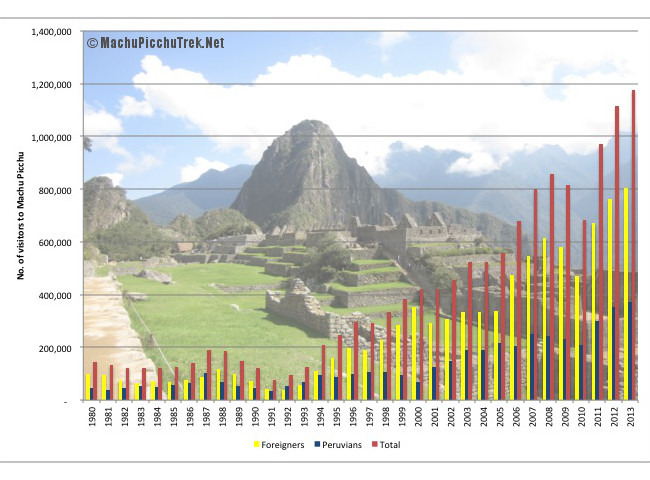
Source: www.machupicchutrek.net
|
|
The number of visitors to Machu Picchu each year has grown from the low 10,000s in the 1980s, to a peak of nearly 1.2 million tourists in 2013 – a 700% increase!
The chart above shows how many tourists visited Machu Picchu annually from 1980-2013. The yellow bar represents foreigners and the green bar, Peruvians.
The chart above shows how many tourists visited Machu Picchu annually from 1980-2013. The yellow bar represents foreigners and the green bar, Peruvians.
Exam corner
Exam Practice: Referring to one example, discuss the strategies that may be used to maintain the carrying capacity of a popular tourist attraction in a rural area (10)
Guidelines: 20 minutes of writing. 1 - 1.5 pages of handwritten work. 10 minutes planning time. Use the A3 worksheet to help you.
**Discuss - Offer a considered and balanced review that includes a range of arguments, factors or hypotheses. Opinions and conclusions should be presented clearly and supported by appropriate evidence**
Guidelines: 20 minutes of writing. 1 - 1.5 pages of handwritten work. 10 minutes planning time. Use the A3 worksheet to help you.
**Discuss - Offer a considered and balanced review that includes a range of arguments, factors or hypotheses. Opinions and conclusions should be presented clearly and supported by appropriate evidence**