Geographypods.com - School Geography
Follow us here
  • Home
    • Contact
    • Blog
    • Site Testimonials
    • Head of Geography
    • Places to Visit
    • Using Mission:Explore
    • Using Twitter
    • Using Facebook
    • Using YouTube
    • Using Streaming Video
    • Using iPad/iPhone
    • Using Google Earth
    • Cross Curricular>
      • History
      • Global Village + Maths
    • Photos (Free to use)>
      • Snow & Mountains
      • Coastal
      • Tropical
      • Urban
      • Sports
  • IB/AS/A2 Geography
    • Useful IB Information
    • Patterns and Change (70hrs)>
      • 1. Populations in Transition>
        • Population Change (5hrs)
        • High & Low Fertility (4hrs)>
          • One Child Policy Videos
          • OCP Brainy Box 2013
        • Migration (6hrs)
        • Gender & Change (4hrs)>
          • Theatre Videos
      • 2. Disparities in Wealth and Development>
        • Measuring Disparities (3hrs)
        • Origins of Disparities (3hrs)
        • Disparities & Change (5hrs)
        • Reducing Disparities (5hrs)
      • 3. Patterns in Environmental Quality & Sustainability>
        • Atmosphere & Change (4hrs)
        • Soil & Change (4hrs)
        • Water & Change (5hrs)
        • Biodiversity & Change (3hrs)
        • Sustainability & Environment (3hrs)
      • 4. Patterns in Resource Consumption>
        • Population Size & Resource Consumption (2hrs)
        • Changing Patterns of Energy Consumption (6hrs)
        • Conservation Strategies (2hrs)
    • HL Global Interactions (70 hrs)>
      • 1. Measuring Global Interactions
      • 2. Changing Space - The Shrinking World
      • 3. Economic Interactions and Flows
      • 4. Environmental Change
      • 5. Socio-cultural Exchanges
      • 6. Political Outcomes
      • 7. Global Interactions at the Local Level
      • Revision
    • Hazards and Risk Management (30 hrs)>
      • Hazards & Disasters
      • Earthquakes
      • Drought
      • Tropical Storms
      • Human Induced
      • Vulnerability
      • Risk and risk assessment
      • Disasters
      • Adjustments and responses to hazards and disasters
    • Freshwater - Issues and Conficts (30hrs)>
      • 1. The Water System
      • 2. Drainage Basins and Flooding
      • 3. Management Issues and strategies
      • 4. Competing Demands for Water
    • Sports, Leisure & Tourism (30 hrs)>
      • 1. Leisure
      • 2. Leisure at International Scale: Tourism
      • 3. Leisure at International Scale: Sport
      • 4. Leisure at National Scale: Tourism
      • 5. Leisure at National Scale: Sport
      • 6. Leisure at Local Scale: Tourism
      • 7. Leisure at Local Scale: Sport
      • 8. Sustainable Tourism
    • Internal Assessment>
      • IA 2011
      • IA 2012
      • IA 2013>
        • Photo Gallery 2012
      • IA 2014>
        • Sitges & Calafell Photos 2013
        • Sitges & Calafell Video>
          • Debrief
    • Extended Essay
    • TOKography
    • Examinations>
      • Y12 Mock 2013
      • Y13 Mock 2013
    • Studying Geography at Uni
    • IB Business & Management (2013)
  • GCSE/iGCSE Geography
    • iGCSE CIE (2012 - 2014)>
      • Key Information iGCSE
      • Theme 1 - Population & Settlement>
        • 1.1 Population Dynamics>
          • 1. Population Growth & Distribution
          • 2. Population Change
          • 3. Migration>
            • Video Diary
        • 1.2 Settlement>
          • NIC
          • MEDC
          • Retail & Shopping
      • Theme 2 - Natural Environment>
        • 2.1 Plate Tectonics>
          • How it works
          • Earthquakes
          • Volcanoes
        • 2.2 Landforms and Processes>
          • Coasts
          • Rivers>
            • Drainage Basins
            • River Features>
              • 2013 RSA Videos
            • River Flooding
        • 2.3 - Weather & Climate
        • 2.4 Interrelationships
      • Theme 3 - Economic Development
      • Coursework>
        • Fieldwork 27.5%>
          • 10A - Videos
          • 10B - Videos
          • Photos
      • Examinations
    • OCR B (2011 - 2013)>
      • 1. Hazards >
        • Introduction
        • Volcanoes
        • Earthquakes>
          • Earthquake Preparation Student Work
        • Tropical Storms
        • Drought
        • Group Work
      • 2. Population & Settlement>
        • Population
        • Settlement>
          • MEDC
          • LEDC
          • Shopping Patterns
      • 3. Rivers & Coasts >
        • Rivers>
          • Drainage Basins
          • River Features>
            • 2013 RSA Videos
          • River Flooding
        • Coasts>
          • Coastal Processes
          • Case Studies
      • 4. Economic Development>
        • Wealth & Development
        • Types of Industry>
          • Introduction
          • Primary Industry
          • Secondary Industry
          • Tertiary Industry
          • Quaternary Industry
        • Multinational Companies (MNC)>
          • Nike Debate
        • Economic Development & Pollution
      • SDME>
        • June 2010
        • January 2011
        • June 2011
        • January 2012
        • June 2012
        • January 2013
        • June 2013
      • Controlled Assessment>
        • Fieldwork 15%>
          • Fieldwork Photos 2012
        • Enquiry (10%)
      • GCSE Examinations>
        • Terminal Exam 12th June 2013
        • Terminal Exam 18th June 2012
        • Y11 Mock January 2013
  • Yr 7 Geography
    • Student Forum
    • Important Information
    • What is Geography?
    • France, Europe & Le Monde>
      • DOM TOM Videos
      • Passport to the EU
    • Map Skills
    • Shake, Rattle & Roll>
      • Tornadoes
      • Earthquakes & Volcanoes
    • Landscape in a Box>
      • 2012 Efforts>
        • 7X
        • 7Y
    • Antarctica Drilling Mission
    • Olympic Games
    • Leicester e-pals
    • End of Year Exam
    • Parent Information
  • Yr 8 Geography
    • Student Forum
    • Question Everything
    • Sheffield FC Enquiry (Map Skills)
    • Kenya Collection
    • Down on the Farm
    • Italia
    • Limestone Landscapes
    • Migration (cover)
    • Weather Enquiry 2013
    • Carcassonne Connection
    • Renaissance Day
  • Yr 9 Geography
    • Student Forum
    • Blue Gold>
      • Student Made Videos
      • Drips v Evian
    • Niagara Falls - Tourism
    • Tundra to Rainforest>
      • Global Biomes
      • Rainforest & Climate
      • The Tribe
      • Palm Oil & Me
      • Palm Oil Assessment
    • Yellowstone Supervolcano
    • Development
    • Global Cooling?
    • Summer World Tour
    • Rocamadour Trip>
      • Rocamadour 2010
      • Rocamadour 2011
      • Rocamadour 2012
    • GCSE Options
    • End of Year Exam

Case Study of a National Tourist Industry
Picture
Objective: To examine the economic, social and environmental impacts of tourism.

Lesson 1 - The theory. 

a. Click here for the presentation and you will also need to the Tourism and Recreation (Access to Geography series). 

b. Complete all tasks as requested using this framework to record your information.


Case Study - Vietnam 

Objective: To carry out a case study of Vietnam as an example of a national tourist industry

Starter: Get a feeling for Vietnam by watching the Michael Palin video to the right hand side. 
Task 1 - Build up your background knowledge of Vietnam by completing the introductory worksheet below. 
building a case study - vietnam

Vietnam Animoto Task (Thanks to Greenfield Geography Wiki) 


ECONOMIC ADVANTAGES
  • It is estimated that the tourism sector employs about 250,000 directly and 500,000 indirectly.
  • In 2006 the tourism industry generated $2.4 billion (3.9%) of GDP. This figure was up from 1.2 billion in 2000.
  • Transport upgrade. Ton Son Nhat airport in Ho Chi Minh City and Noi Bai airport in Hanoi have both been rebuilt.
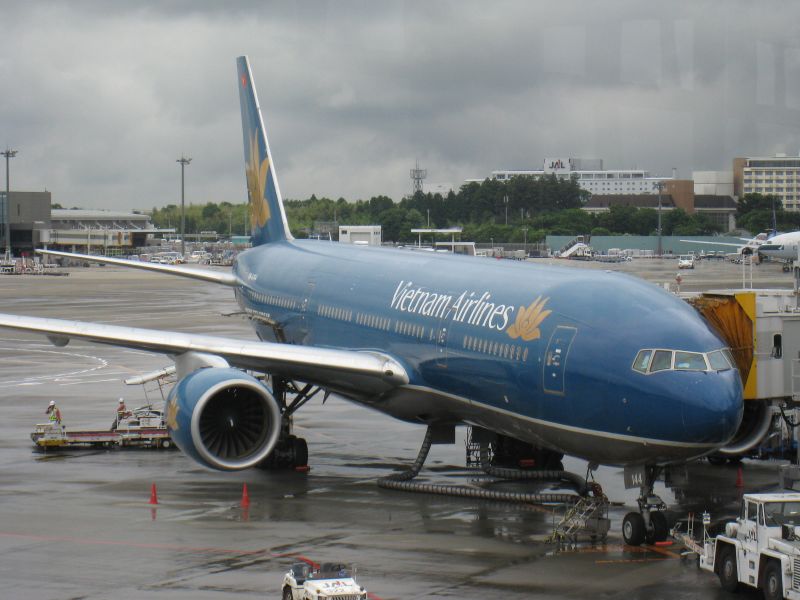
  • Increase in air routes. As well as the state owned airline, Vietnam Airlines other international airlines like, United Airlines, Lufthansa and Air France fly to Vietnam.
  • The Reunification Express (trainline) is also been upgraded along with Highway 1 running the length of the country.

ECONOMIC DISADVANTAGES
  • Economic leakage. Many tourist developments e.g. Sheraton and Hyatt Hotels are partly owned by foreign companies. This means that some profits leak overseas and are not reinvested in Vietnam.
  • Inflation. The increased demand created by tourist can create rapid inflation. The value of land can go up, along with transport and even food.
  • Small businesses find it hard to compete with large TNCs, often causing local businesses to go out of business and increasing economic leakage.
  • Pressure on services. New resorts, restaurants, golf courses, etc. can put a huge strain on the local infrastructure. This can cause congestion, black-outs. etc.
  • Seasonal employment. Like El Salvador, Vietnam has a dry and wet season. Many tourist choose to visit in the dry season, meaning that many people lose their jobs during the wet season.

SOCIAL AND CULTURAL ADVANTAGES
  • Important cultural locations like Hue Citadel, My Son and the Temple of Literature are being afforded greater protection as more tourists visit.
  • Some minority cultures are being promoted e.g. Cham and M'Nong. It is possible to visit their villages, sample their food, by their crafts and even try and learn their languages.
  • Tourism is encouraging greater entrepreneurship and improving language skills e.g. tour guides and taxi drivers.
  • New services are built and developed which benefits tourist and local residents alike e.g. golf courses (Song Be) and hospitals (FV Hospital)
  • Money is spent on improving and building museums which protect cultural heritage e.g. War Remnants Museum and Ethnology Museum.
  • Infrastructure improvement like new roads, new water treatment facilities, new electricity plants can be used by tourists and residents alike.

SOCIAL AND CULTURAL DISADVANTAGES

  • A big worry in many developing tourist destinations is the growth of sex tourism, especially amongst the recruitment of young boys and girls.
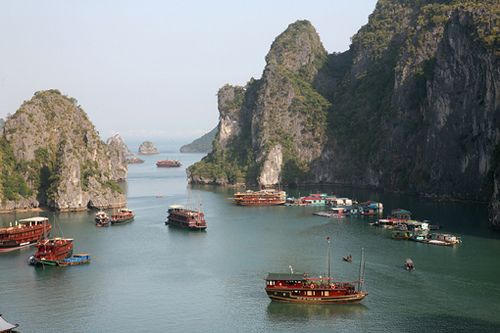
  • Sometimes the tourist industry can outgrow safety regulations and accidents can happen such as the tourist deaths in Halong Bay with the sinking of a tourist boat.
  • Privatisation of land. As tourist resorts are built, beaches and forested areas become privatised reducing access to local residents.
  • Rapid economic development can lead to a polarisation of citizens economic status. The economic divide can cause an increase in crime e.g. bag snatching.
  • Westernisation. The arrival of tourists can cause a decline in local cultures e.g. loss of language, food and clothes.
  • Rural-urban migration. People can be drawn towards areas where investment and growth is taking place. This can lead to core and periphery areas and also rural depopulation.

ENVIRONMENTAL ADVANTAGES
  • Greater protection of the environment. Vietnam is considered a country of biodiversity. It has leopards, elephants, tigers and even the highly endangered Javan Rhino. With tourist interest new national parks are being created e.g. Cat Tien National Park and being protected more.
  • Demining. The growth of tourism has seen areas be de-mined making areas safer for tourists and local residents alike. One de-mining charity operating in Vietnam is MAG.

ENVIRONMENTAL DISADVANTAGES

  • Nearly 80% of international tourists visiting arrive by air. This is going to cause an increase air pollution and contribute to global warming.
  • Tourist development can often lead to deforestation and damage to sand dune systems. Vietnam has seen massive growth along the coast near Mui Ne and Hoi An
  • Pollution. An increase in hotels and tourist facilities can cause water, air, noise, visual and water pollution

POLITICAL ADVANTAGES
  • The government is seeing an improvement in its international standing. Vietnam has recently hosted the APEC summit and became a member of the WTO in 2007.
  • The government will see an increase in tax revenue and a reduction in unemployment.

POLITICAL DISADVANTAGES

  • As more Vietnamese are exposed to Western influences and ideas there might be a greater call for political reform. Vietnam currently has a one party system.
  • The government will have to balance growth with inflation and attempt to ensure that infrastructure development

Your task - In teams of three, you will be creating a 30 second revision video on Animoto showing one of the S.E.E factors and how it relates to tourism in Vietnam.

Instructions: Create an account (Lite Free 30 second videos) - Use your school email address and enter your name/nickname and a password. You're ready to go. 

Task 1 - Images
Choose either Social Cultural, Economic or Environmental (your teacher will do Political) and find 5 images that represent positive and 5 that represent negative. Save these in your My Pictures folder. (there are some pictures to the right which are free to use)

Task 2 - Captions
Write out your captions on a Word document. These will be inserted into the video before or after your images. Your teacher will show you how this works. 

Task 3 - Uploading and YouTube
Upload your images and captions to your video and let Animoto do the rest. Choose some music too for extra effect. Once it has been complete, upload to your YouTube account (IST students, you have one ending with your .eu email address)

Student Animoto Videos 2012 

Picture
Picture
Picture
Picture
Picture
Picture
Picture
Picture
Picture
Picture
Picture
Picture
Picture
Picture


Case study of eco-tourism

Picture
Objective: To evaluate the strategies designed to manage and sustain the tourist industry.

The market for traditional tourism is still strong, but increasingly people are looking for destinations further and further afield to experience new cultures, traditions and languages. 

Starter: Watch the two 'Idiot Abroad' videos beneath (note strong language) to see the sorts of activities that tourists partake in. 

Background reading - Guardian Online Article May 2012

You will need Integrated Approach' - Waugh and 'Leisure, Recreation and Tourism' - Prosser for these activities.


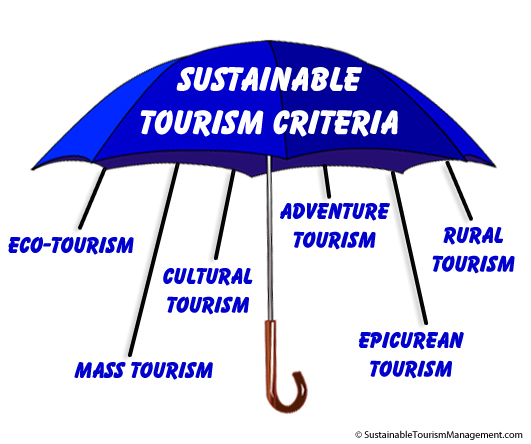
Ecotourism: Ecotourism is responsible travel to fragile, pristine, and usually protected areas that strive to be low impact and (often) small scale (as an alternative to mass tourism).
Carrying capacity: The maximum number of people that may visit a tourist destination at the same time, without causing destruction of the physical, economic, socio-cultural environment and an unacceptable decrease in the quality of visitors' satisfaction.The IB splits carrying capacity into environmental carrying capacity and perceptual carrying capacity. Environmental carrying capacity is the maximum number of visitors before environmental harm is done. Perceptual carrying capacity is the maximum number of visitors before visitors consider an impact like noise to be excessive.
sustainable tourism information sheet

Credit: Thanks to Greenfield Geography Wiki for this information

Task: Produce a two sided A4 fact sheet about either a sustainable tourism or ecotourism initiative for a location of your choice.  

Use the What? Where? When? Why? Who? approach and try to cover as many of the SEEP +/- as possible. 

Possible examples:
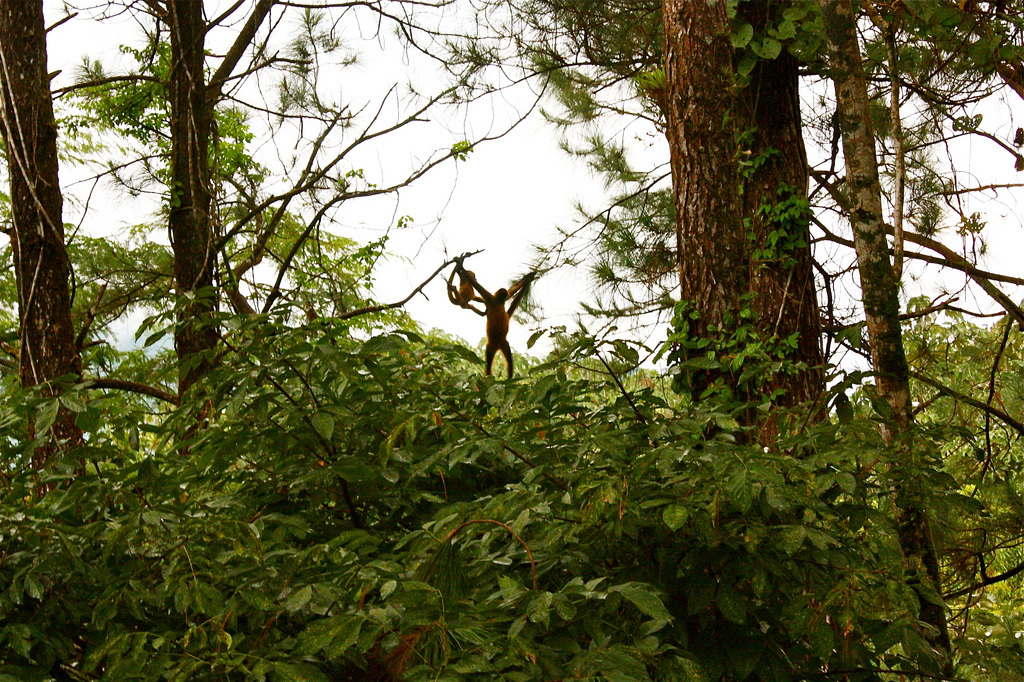
1. Costa Rica - Monteverde Cloud Forest - Link (also see the PDF document to the right hand side) 

2. El Salvador - Link

3. Sarawak, Malaysia - Link (Word Document)

4. Kerala India - Link 

Sustainable tourism: Sustainable tourism is tourism attempting to make a low impact on the environment and local culture, while helping to generate future employment for local people. The aim of sustainable tourism is to ensure that development brings a positive experience for local people, tourism companies and the tourists themselves. Sustainable tourism is not the same as ecotourism.
Picture
costa rica ecotourism pdf study
Picture

Tourism as a development strategy

Picture
Objective: To assess the importance of tourism as a development strategy for low-income countries.

Watch the six minute tourism video at the bottom of this page.

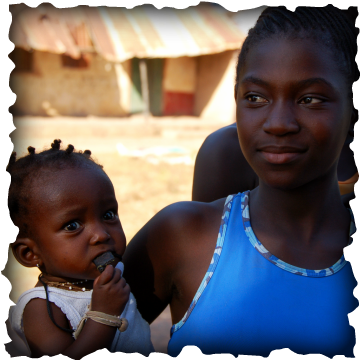
We will be focusing on The Gambia for this small unit of work. Click here to be taken to a fact-sheet about tourism and The Gambia.

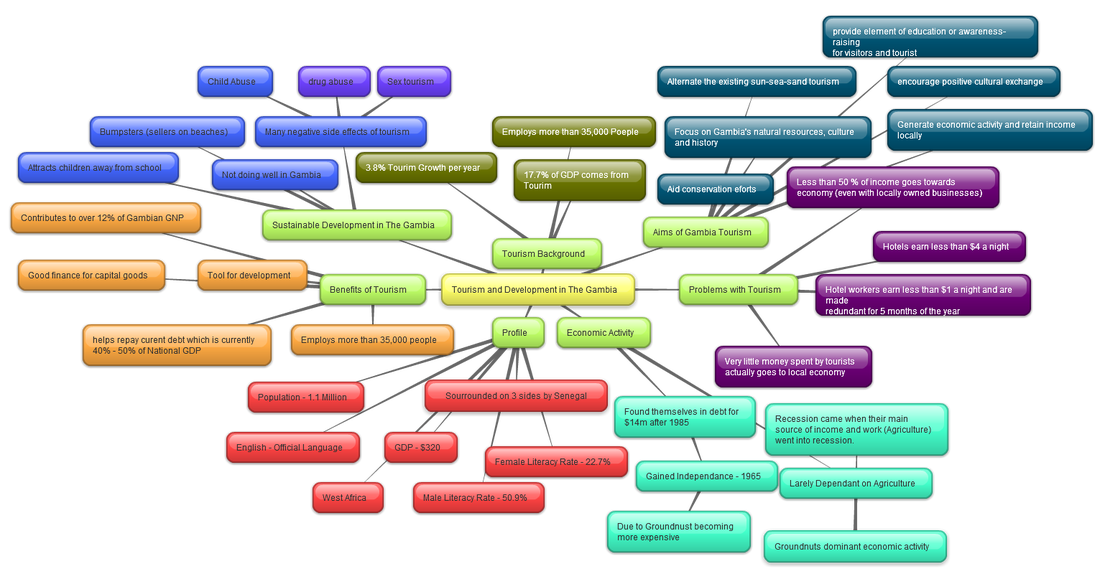
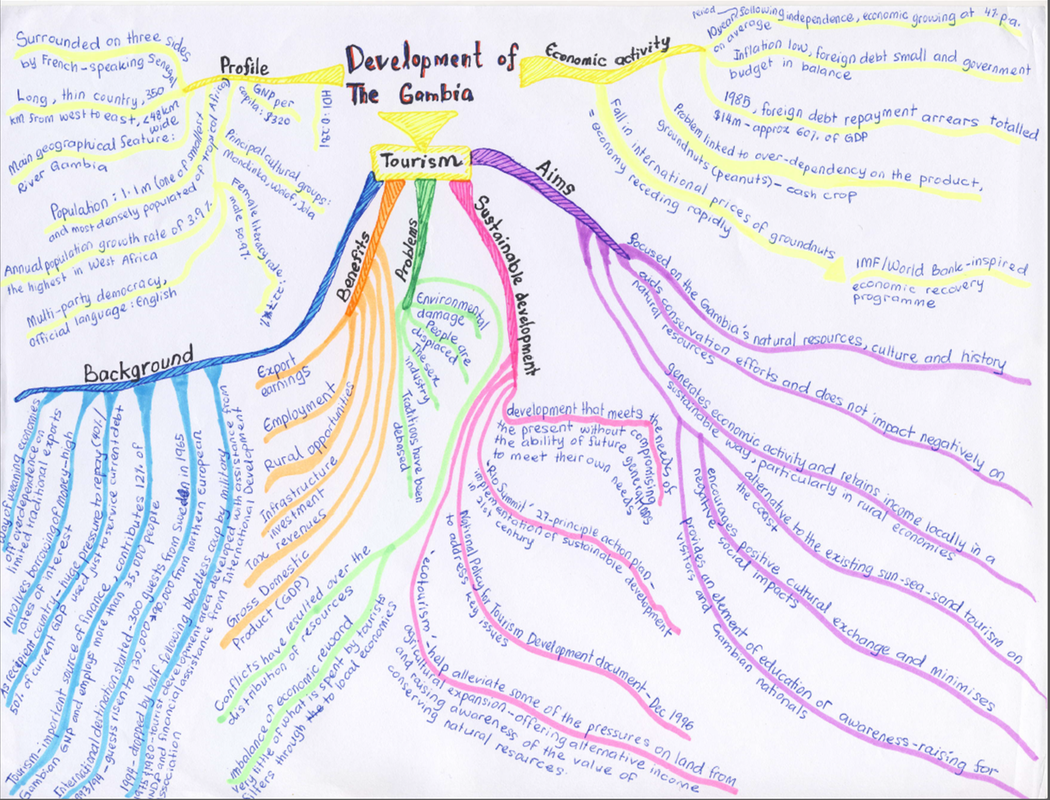
Task 1. Construct a mind map using the following website using the following titles as 'legs'. Remember, you only need a few words for each.  You will need to sign up to the site, but it is free. Use your school email address.  You may of course complete this by hand - see example completed by S. Rizal at the foot of this page.
 
a. Gambia - Profile
Include population stats, location, GNP, language, literacy rates.

b. Economic Activity
Include foreign debt levels and reason for overdependence, cash crops, tourism.

c. Tourism Background
Include % of GDP, numbers employed, growth rates.

d. Benefits of Tourism in The Gambia
Include the information in Figure 3 - Table - Benefits of Tourism.
 
e. Problems caused by Tourism in The Gambia
Include information on flow of income out of the country, % profit made by the country, wages, skilled jobs.

f. Sustainable Development in The Gambia
Include information on definition of sustainable development, issues in Gambia, unemployment, new initiatives.

g. Aims of Gambia Tourism (Fig 5 on the last page)
Highlight the main aims.

Task 2. Read 'The Gambia: Paradise or Purgatory?
On your copy of the article, highlight and annotate the areas that point towards tourism as being a development strategy for the country. Are there any areas where you can see possible exploitation taking place?

Task 3 - IB Essay style question: 

Western style tourism brings only mimimal advantages to LEDC destinations and widens the development gap even further. To what extent is this statement true? (15). 
  

Introduction to The Gambia
Watch this before completing Task 1.

Example of Student Mind Map -
Thanks to S.Rizal & R. Walker @ IST
Picture
Picture

Creative Commons Licence - Please use but credit
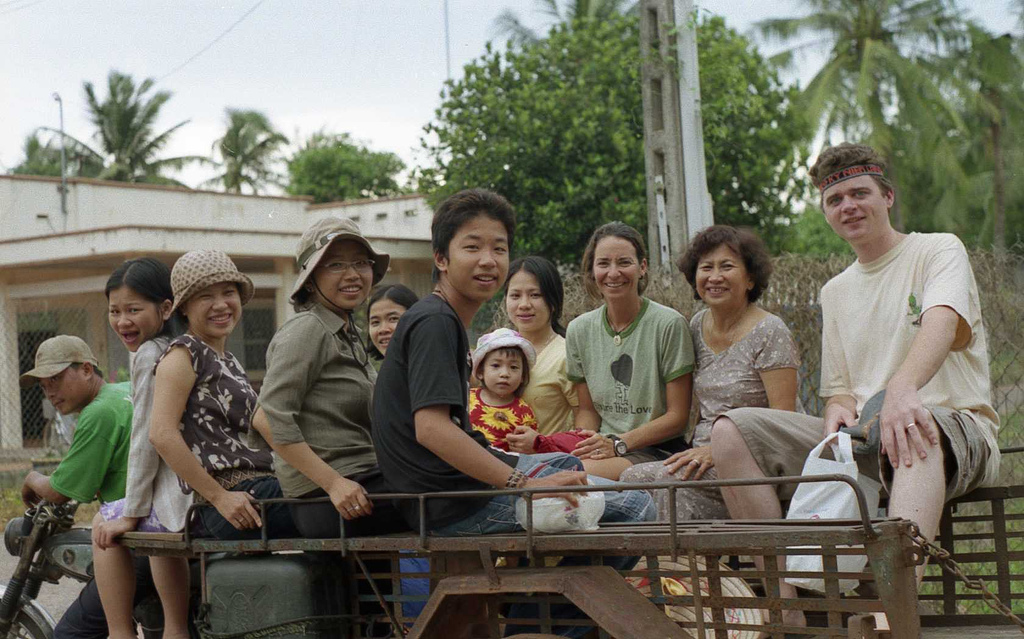
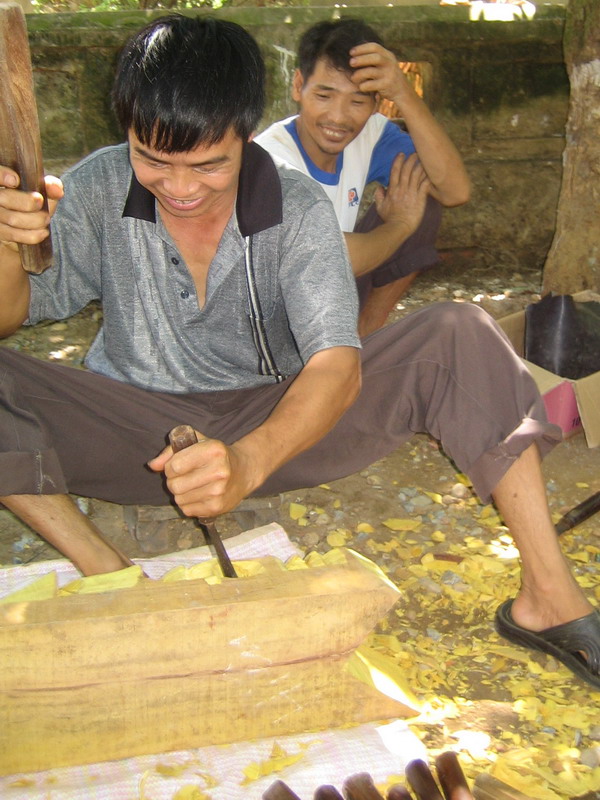
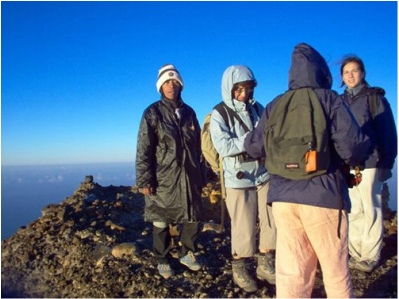
Photos used under Creative Commons from kashmut, michale, seafaringwoman, Binder.donedat, archer10 (Dennis), archer10 (Dennis), Maria Hsu, Jame and Jess, dms_303, DavidJGB, Doogsta, Don Fulano, gerrypopplestone, ^riza^, ys*, Bohari Adventures, manalahmadkhan, xavi talleda